-
Average rating
21
Games
0
Votes cast
Heartbeat
Shipped Titles
Games (21)

World Defense : A Fragmented Reality Game
Hobbisoft2016
Tower defense as you've never experienced it before. We take tower defense to your home, your neighbor's house, the Seattle Space Needle, or anywhere in the world; the choice is yours. World Defense is the first, physics based, 3d tower defense where anything and everything depends upon real world simulations.
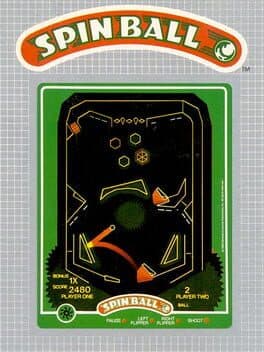
Spin Ball
GCE1983
Spin Ball is a pinball simulation game. The games pinball table comes complete with a variety of bumpers, spinners, and other targets which can earn you varying amounts of points with several combinations possible for even more points. Bonuses can be earned as well, both in point form and also ball savers which block the chutes on the corners of the screen. A ball splitter may also appear, allowing you to have two balls in play at one time. The joystick is used to set the tension on the spring when putting a ball into play or to shake the table during play, and the buttons are used to control the left and right paddles on the table. You begin each game with 5 balls, and the game ends when all 5 are lost.
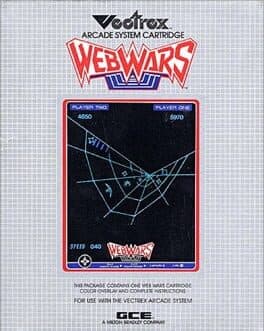
Web Wars
GCE1983
Web Wars release for Vectrex video game system
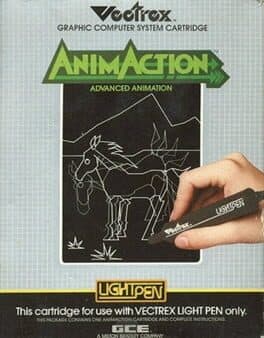
AnimAction
GCE1983
AnimAction is one of the Vectrex titles that requires the light pen accessory to operate. The light pen pack-in cartridge Art Master, only had rudimentary animation capabilities... AnimAction takes animating your vector based artwork to another level. An interesting fact about the AnimAction cartridge is that it is not an any of the the aftermarket multi-carts because it had extra memory built in to save your artwork, making it a more desirable program cartridge for your Vectrex collection. let's face it... there is something cool about seeing your own art moving about on the screen of a gaming console that is over a quarter century old! This is one of the software releases where GCE broke out of the "games only" mold and endeavored to make more interactive and educational programs for this awesome vector based platform.
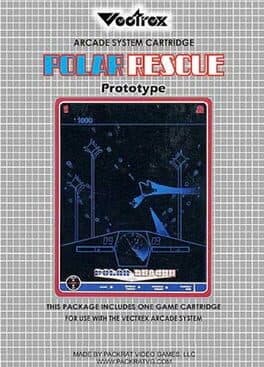
Polar Rescue
GCE1983
The player controls a submarine in hostile waters and must rescue the survivors of a mission which ended in disaster. Enemy submarines surround and will fire upon the player's ship if it enters sonar range. Each enemy submarine can fire up to five torpedoes; however, if it is destroyed before it uses all of their torpedoes, the remainder will be added to the player's arsenal. Other obstacles which must be avoided are mines, ice chunks and turbulent underwater whirlwinds. Once the survivors are located, it is necessary to dock with their pod, which the player has to approach with accuracy and care. A new mission will begin with a successful rescue.
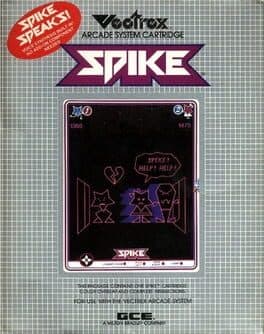
Spike
GCE1983
The evil Spud has taken Spike's girl, Molly, and Spike must make his way through various levels on platforms and ladders to rescue Molly. You must move the ladder from platform to platform and jump gaps to retrieve the key that will set Molly free from her cage. But be careful, Spud has evil bounces and birds he has sent out after you! You can defend yourself by kicking right or left. You can play either one player or two player mode where each player takes a turn with a single joystick controller. Who will save the fair Molly first and win her affection?
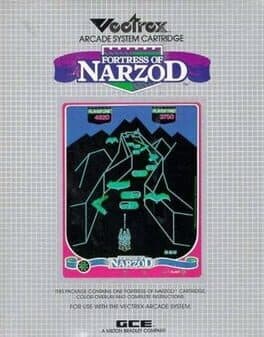
Fortress of Narzod
GCE1983
The player controls a hovercraft on its ascent up a mountain range with the goal of reaching the fortress at its summit. Each screen is part of a roadway, which is defended by three waves of guardians. These waves of guardians consist first of the Doomgrabbers, then the Tarantulas and finally the Ghouls. Each wave makes its descent down the roadway and towards the player, which all of one wave needs to be destroyed before the next wave begins its descent. Contact with enemies or the Spikers which are randomly released from the Doomgrabbers will result in the loss of a life. The player's own fire has the ability to ricochet off the walls of the roadway. This not only has the benefit of creating angles, which the player may destroy the enemies without them being able to return fire, but can also be a disadvantage due to the ability for the shot to return and destroy the player's ship. After three waves, the player is allowed to move up the screen and to the next roadway. Each roadway has the same enemies, although in increasing numbers. With the second roadway comes the addition of the Warbirds, who fly over the entire mountain and are able to fire at the player in the third roadway. Once three roadways have been
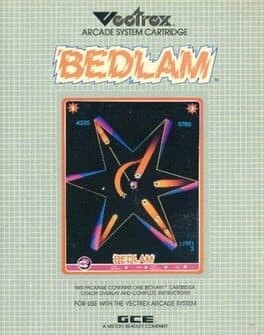
Bedlam
GCE1983
In the arcade game Tempest, players controlled a blaster that could move around the outermost lanes of a bunch of geometrically-shaped levels and fire at ships that emerged from the middle or innermost areas of those levels. Bedlam, however, was a "Tempest in reverse", where players' ships (resembling the Millennium Falcon from several of the Star Wars movies) sat in the middle of sectors while ships emerge from points of those sectors and came inwards towards the player. Players turn their ships left and right and can spin them around quicker with the Fast Rotate button. Also, Zap, like the Superzapper on Tempest, will destroy everything onscreen and can only be used once per sector. There are several different types and mannerisms of enemies as well as sectors. Getting rammed by an enemy will cause the player to lose a ship in reserve and the game will end once the player has no more remaining ships.
Art Master
GCE1983
The Light Pen is an accessory for the Vectrex released in 1983 by GCE. It was quite revolutionary for its time, but because of the Great Video Game Crash of 1983, it ended up as a commercial failure. Packed in with the accessory was the game Art Master. During its lifetime, GCE managed to release three games for it: Art Master, Melody Master and AnimAction. There was also a prototype, Mail Plane, that never managed to get a release.
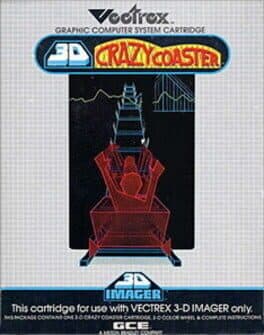
3D Crazy Coaster
GCE1983
You control the movements of the passenger in the lead car as he plummets down the spectacularly steep hills and careens around the gravity-defying curves of the Crazy Coaster. Will you be able to keep his arms raised throughout the ride without sending him flying off into space?
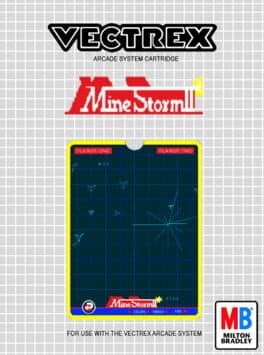
Mine Storm II
GCE1983
Tread lightly! The transport lanes of intergalactic space have been seeded with mines from an alien vessel. Use your mine destroying blaster to blow up the mines before they annihilate you! You may survive the floating mines, but beware of the fireball, magnetic, and treacherous fireball-magnetic mines . . . 13 fields, each one more difficult, await you!
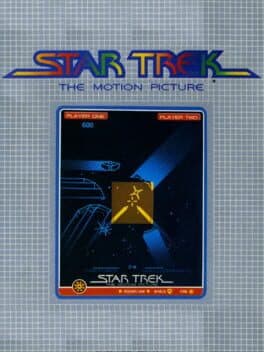
Star Trek: The Motion Picture
GCE1982
The object of this game – a basic "shoot-'em-up" style game for one or two players – is to travel through space and destroy Klingon and Romulan ships.
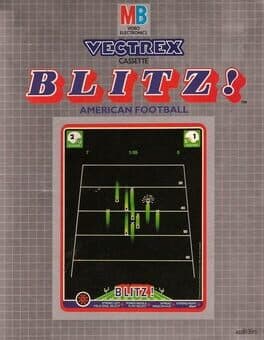
Blitz!
GCE1982
Blitz! is a simulation of American football. Each player (which the game supports a simultaneous two player mode) controls one member of their team on offense and defense and the basic objective is to move the ball up the field to reach the opposition end zone. This is done using a series of "downs", there being four downs available to move the ball ten yards forward. If a player fails to achieve that then the ball turns over to the opposition offense. The player can also score by opting to attempt to kick the ball between the opponent's goal (called a field goal and worth fewer points than a touchdown).
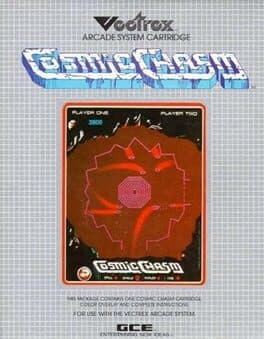
Cosmic Chasm
GCE1982
With the beginning of a new game, a map screen is shown with the player's position, as they control a ship set in a series of interconnected caverns. They must first plan out the best route in order to get to the central area in each Mission. After several seconds, the map screen changes to a cavern that the player is currently in, which each cavern has a core in the center that is constantly growing, as well as having several Planet Protector enemies. It is usually in the player's best interest to clear out each area of Planet Protectors by shooting them, then carefully inching their way to the protective barrier by an exit in order to drill through it. Once the barrier has been disabled by the drill, the player can then fly into the next cavern and thereby gets a step closer to the central area. The view changes from a cavern to the map screen with each cavern that they pass, showing the player's(') progress. Once the central central area is reached, the player(s) must drop a bomb at the center core, which they have several seconds in order to escape from the area before the bomb explodes. If the player does not make it out in time they will lose a ship; succeed and they will start again on a new area/Mission. Hitting a cavern wall, core or a Planet Protector will cause players to lose a ship and the game will end when there are no ships remaining. Exiting a Mission without leaving a bomb at the central core will cause the player to lose a ship as well, along with restarting the current Mission (if they have any remaining lives left). Also when the player loses a ship without clearing out all Planet Protectors in a cavern, that cavern's full complement of Protectors are totally replaced once the player's next ship comes into play. Players have a protective shield for use in emergencies, however.
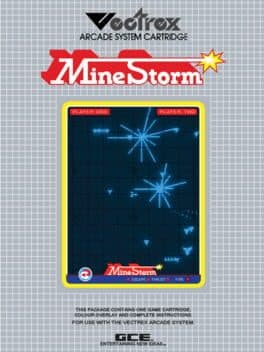
Mine Storm
GCE1982
The game begins with a large enemy ship dropping mines onto the field as an ominous jingle plays, and moves from the top to the bottom of the screen, where it disappears. The player's ship starts in the middle of the field with 5 lives. Numerous mines then start popping up. The player must destroy all of the mines in order to progress to the next minefield. All of the mines can be destroyed with one shot, or hit with the player's ship, costing the player a life. There are 4 types of mines.
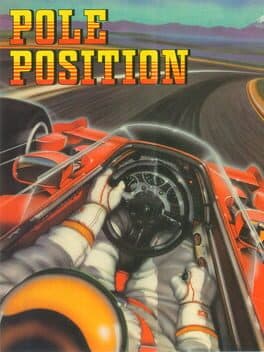
Pole Position
Namco1982
The very first racing game with the rear perspective camera and track based on real life.
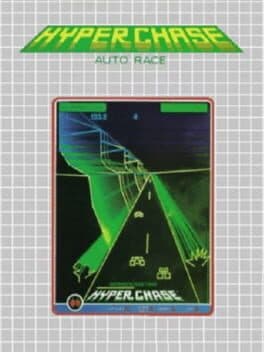
Hyperchase Auto Race
1982
The player controls a formula one race car whose objective is to advance through the rankings and either make the best time or accumulate as many points as possible depending on the game selected. In Game 1, the player has unlimited cars and their goal is to finish the course in as little time as possible. In Game 2, the player receives 5 cars and the goal is to accumulate as many points as possible. In both games, collision with either the edge of the track or other cars results in the loss of a life and the player is forced to start from a speed of zero.
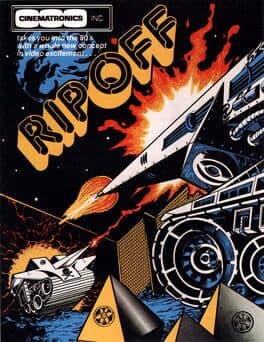
Rip Off
Cinematronics1980
Rip-Off is a vector shoot 'em up released in arcades by Cinematronics in 1980. It is the first shoot 'em up arcade game to feature cooperative gameplay and the first game to exhibit "flocking" behavior. The objective is to prevent computer-controlled enemies from stealing eight canisters set in the center of the screen. One or two players control tank-like vehicles while game-controlled "pirate" tanks rush onto the field and attempt to drag the canisters off the edge of the screen. Enemies can be defeated by shooting or colliding with them. The game speed and difficulty increase with each successive wave until all the canisters have been taken ("ripped off").
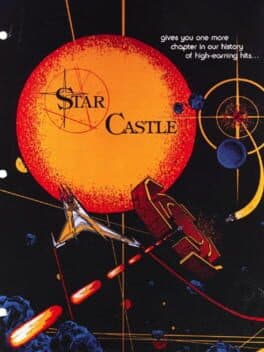
Star Castle
Cinematronics1980
Star Castle is a 1980 vector arcade game by Cinematronics. The game involves obliterating a series of defenses orbiting a stationary turret in the center of the screen. The game was designed by Tim Skelly and programmed by Scott Boden. Tim Skelly also created a number of other Cinematronics titles, including Starhawk, Armor Attack and Rip-Off. As with many other titles by the company, Star Castle was ported to the Vectrex video game console in 1983.
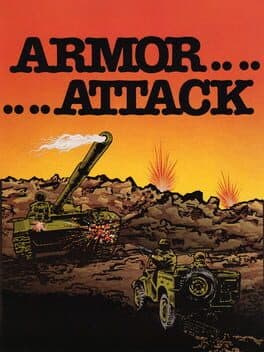
Armor Attack
Cinematronics1980
Armor Attack is a tactical 5v5 PvP battle game where robots, tanks, and hovers clash for battlefield control. Combine powerful weapons and unique abilities to outmaneuver your opponents.
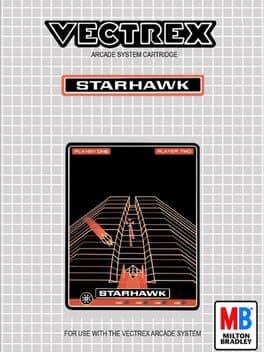
Starhawk
Cinematronics1979
Starhawk is a 1979 vector arcade game by Cinematronics. Starhawk is a shoot 'em up with a fixed environment. The game was unique at the time as it presented the graphics in a pseudo-three dimensional way. Essentially, the game is a simple video game version of the Star Wars: Episode IV trench run. The game was later ported to the Vectrex video game console in 1982. The game is remembered as having quite advanced graphics for the time and being the first video game based upon or to have noticeable references to Star Wars.