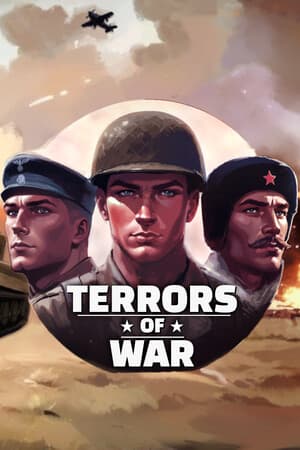
Terrors of War
Base-building WW2 RTS. The Reich is collapsing, and burying something the Allies were never meant to find. Command US or Wehrmacht forces. Run supply lines under fire. Push forward depots. Unleash artillery and superweapons. Fight the war you know, while you still can.
N/A
VGDB Score
Be the first to review
Overview
Summary
Base-building WW2 RTS. The Reich is collapsing, and burying something the Allies were never meant to find. Command US or Wehrmacht forces. Run supply lines under fire. Push forward depots. Unleash artillery and superweapons. Fight the war you know, while you still can.
Description
About This Game
A base-building RTS with persistent frontlines. Launching in Early Access.
In the spring of 1945, the Reich is breaking apart above the ground and burying itself below it. What goes underground is not just men. It is doctrine. It is research. It is a promise made in rooms the Allied advance will never reach in time.
That promise will be kept.
Until then, there is still a war to finish. Yours.
What You're Getting
A WW2 RTS where supply lines run to the front under fire
Procedurally generated maps across 5 biomes: desert, forest, plains, snow, arctic. Find a layout you love? Send the seed. Your friend plays the exact same map. No Workshop needed, just a number
Two playable factions with asymmetric tech: flexibility versus commitment
Three handcrafted Operations, plus a Capture-the-Facility competitive mode
Deterministic lockstep multiplayer. AI takes over when a player drops, push-to-talk voice, post-match line graphs
Replays you can scrub, share, and cast in real time
A solo-dev game that ships fixes you asked for, in the next patch
A war the Allies thought they had finished. Until it came home
Supply Lines Are The Battlefield
You do not farm a second resource. You run one. Trucks roll from your base to Supply Caches on the map, carrying everything you need to build and fight. Every convoy is exposed the moment it leaves base. Every ambush is a real setback, not a rounding error.
Field Depots let you plant a pocket of strength wherever the fight is. Every depot commits to one role: offense, defense, or agility. Units in its aura feel the full buff, not a sprinkle of everything. Depots do not produce supply. They spend it while their units are fighting. A quiet sector costs almost nothing. A frontline depot is only as strong as the convoys keeping up with it.
Static defenses draw from the same pool. Bunkers, anti-tank guns, and emplacements burn through their reserves magazine by magazine. Cut their convoys and the rounds run out. Concrete without resupply is just a monument.
Lose the caches near you and the front dries up.
Escalation, Not Attrition
Matches start with rifles and half-tracks. They end with artillery barrages, heavy armor, and V2 rockets falling on positions that felt safe a minute ago. The US researches what it needs. Germany commits to a doctrine. Two different relationships with the tech tree, by design. Call in paradrops, scout sweeps, strafing runs, artillery, and emergency repairs to break a stalemate, and watch them backfire if you mistime the window. Turtling has a cost. The player who keeps pushing has the advantage.
Territory That Matters
Supply Nodes across the map grant one of three advantages. Economic nodes feed your income. Population nodes raise your army cap. Vision nodes reveal the ground directly around them. Capturing them forces expansion. Holding them forces commitment. The map is not a backdrop. It is the fight.
Maps That Don't Repeat
Skirmish maps are procedurally generated across five biomes: desert, forest, plains, snow, and arctic. New terrain every match. No memorized layouts.
Find a seed worth keeping and the entire map is a single integer. Send it on Discord. Your opponent boots into the exact same terrain.
Multiplayer and gameplay get the focus during Early Access. As those mature, map work expands. More procedural options, handcrafted maps, or both. Diversity stays the goal.
The War You Don't Know
A sub-faction within the regime who went underground in the last months of the war. They called themselves Die Schatten. The Shadows. Scientists, fanatics, and those who refused to end the war on the enemy's terms. They took research with them, and a doctrine that harvests corpses, wrecks, and ruins for raw material.
They were worse than the regime that surrendered. An evil that was nurtured, not born. They are the cost of propaganda that became religion.
They were waiting. They were not done.
By the end of Act II, the war the Allies thought they had finished has crossed the Atlantic.
Act II is told mostly from inside Schatten command. You play their rise.
At Launch (Early Access)
Two playable factions at launch, US and Wehrmacht, with asymmetric tech and distinct unit rosters
Skirmish against AI across multiple difficulty tiers, from learning the systems to brutal
Co-op skirmish: team up with a friend against the AI
Three handcrafted WW2 Operations, plus a Capture-the-Facility competitive mode
Procedurally generated skirmish maps across 5 biomes with shareable seeds
Every match auto-records as a scrubbable replay, with a caster overlay for observing other players' resources and pop at a glance
Ranked multiplayer across 1v1, 2v2, 3v3, and 4v4. Global leaderboards per mode and per faction. Push-to-talk voice. AI takeover when a player disconnects
Post-match summaries with per-player line graphs, so you can see where the match was actually decided
Multiplayer
Matches run on deterministic lockstep. Both peers simulate the same battle from the same inputs.
Quick-match drops you into a game, or browse the lobby list and pick your fight. Invite friends through Steam.
Push-to-talk Steam Voice on your team channel. Team-vote surrender for when the match is genuinely over, so nobody is held hostage by a teammate who refuses to call it. If a player disconnects, the AI takes over their forces until they reconnect.
Global leaderboards for each mode and each faction. Climb where you actually compete, not in one pooled ranking that hides how you play. Friends-only tabs so you can ladder against the people you actually play with.
Every match auto-saves as a replay you can play at any speed and share on Discord. A caster overlay lets you observe with per-player resource and population at a glance. Post-match summaries show a line graph of the things that mattered, so a loss teaches you something.
Anti-cheat runs from launch, in layers that are not listed here for a reason.
The Road Ahead
Early Access is where the game grows. Act I is what ships now: skirmish, three Operations, multiplayer. Act II is the campaign that lands during Early Access. More units. More maps. More superweapons. Balance shaped by people actually playing.
Act II is the long horizon. Die Schatten breaks cover. New faction, new units, new mechanics built around their doctrine of recycling, bioweapons, chemical agents, and anything else their scientists could make work in a lab.
The Soviets are in this war. Not always beside the Allies. Not always opposed. They will need each other when it matters most, whether they trust each other or not.
Seasonal leaderboards, community tournaments, and the features that only make sense once a larger community exists.
Built Alone, Built For Real
Terrors of War is a one-person project. I have been building it for years because the WW2 RTS I wanted to play did not exist. Something in the lineage of the command-heavy RTS I grew up on, deepening the supply system instead of replacing it.
The netcode is lockstep. Anti-cheat is active from Day 1, because the first wave of cheaters can kill a community that is still forming. Workshop support for community-authored AI is planned post-launch.
Your feedback does not go into a suggestion box. It goes into the code, in the next patch. Every system you see on this page came from someone like you asking for it.
Post-launch support continues through Early Access, 1.0, and beyond.
Join the Discord
Share replays. Argue about balance. Send me your best clips. Shape the patch notes.