A whole RPG in a strip on your desktop
Taskforge doesn't run fullscreen. It lives in a borderless strip floating above whatever you're already doing — and inside it your heroes fight, die, level up and bring back loot while you work.
It takes your desktop, not your attention
Drag the strip anywhere: the position is saved per monitor. Pick one of three sizes and decide whether it stays on top. Found a good stage to farm? One click on the strip pins it. Closed the game? Your heroes keep earning gold and XP, your eggs keep hatching, and a summary tells you exactly what came in when you get back.
Combat is automatic. The decisions are yours
Nobody clicks attack, target or ability. You command four things, and that's where the game lives:
- Gear — which item goes on which hero
- Party — who's in and in what order, because whoever stands in front takes the hits
- Talents — where each level-up point goes
- Where to farm — which stage and which difficulty to repeat
Four heroes, three slots
All available from the start — there's no recruiting, there's choosing. The
Guardian is the only hero who can push damage reduction to 85%; everyone else tops out at 50%. The
Ranger turns attack speed into damage from range. The
Arcanist is the only one whose every blow hits two enemies. The
Cleric heals the whole party as long as they're alive on the field. You start with one slot, and each of the first two bosses you defeat opens another. Changing the lineup has a price: a fallen hero can't be swapped out, and every swap puts both heroes on a one-minute cooldown.
Three skill branches per hero
Every level grants a talent point. Each hero has three branches — offense, defense and utility — and each one grants an active skill you shape point by point: cooldown, duration, targets, trigger. Twelve skills in all, from the Guardian's Iron Fury to the Cleric's Litany, and a keystone at the end of every branch. Skills fire on their own and play out on the strip, and the skill card always tells you, with your hero's current numbers, when it fires, on whom and what it does. You can respec — and it costs more the higher your level.
Every hero wears their own set
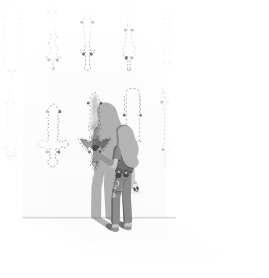
Six of the nine slots are class-locked — weapon, off-hand, chest, helm, gloves and boots — and the main stat of each piece comes from the class itself: the Guardian's helm and gloves are armor, the Ranger's buy critical chance and attack speed, the Arcanist's buy critical damage and raw damage, the Cleric's buy XP gain and item find. Only the three accessories move freely between heroes. A drop meant for someone else is never wasted: break it down and craft the piece you actually want.
Loot that changes the sheet, not a power number
Nine slots, 54 base items, six rarities and affixes with rolled values — what the item card says is exactly what lands on the hero's stats, and before you swap the card lists what you gain and what you lose. Two bases of the same type aren't the same thing: the focused piece concentrates the main stat and gives up an affix; the broad one keeps your options open.
A Workshop for every item you keep — and every one you don't
Upgrade up to +20, with the success chance shown before you click: a failed attempt costs gold, never the item.
Enchant rerolls the value of one affix;
Transmute rerolls them all.
Discard breaks items down into shards or sells them for gold, and
Craft turns shards into exactly the piece, rarity and level you're missing.
Sockets and stones
From Hard difficulty on, epic, legendary and mythic pieces can roll sockets. Stones drop from enemies with a random stat — or you craft the one your build needs, at a steep price. Combine seven to climb a tier. A socketed stone is permanent: it stays in the piece or it breaks.
Pets hatched from eggs
Enemies drop eggs in six rarities. Put them in the Nest and they hatch in real time — twenty minutes for a common egg, a full day for a mythic one — with a queue you arrange so the right egg hatches overnight. Ten pets, and most of them change how you farm rather than how hard you hit: gold per kill, stone and egg chance, upgrade cost, offline time, boss cooldown. One pet joins the party and follows it along the strip.
Five acts, fifty stages, three difficulties
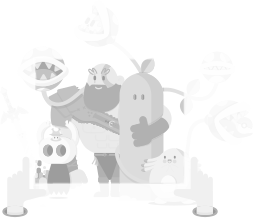
From the Oldstone Fields to the Ember Citadel: twelve enemy species with distinct silhouettes, an elite closing every stage and a boss at the end of every act. Bosses fight in phases: they attack in bursts, and at two thirds and one third of their health they unleash their signature skill — and the melee bosses carry a second one aimed at the heroes in the back. Every stage resolves in under five minutes: the party clears it or dies trying. Before each boss, the Portal shows its health, its damage, its skills and the preparation that beat it.
Pixel art made for the strip
Every hero and every enemy reads by silhouette alone, in a sprite small enough to fit a 132-pixel band and clear enough that you know what's happening out of the corner of your eye.
Five languages
English, Brazilian Portuguese, Simplified Chinese, Latin American Spanish and Russian.