Dispatch
Dispatch
Keep Reading

 Token
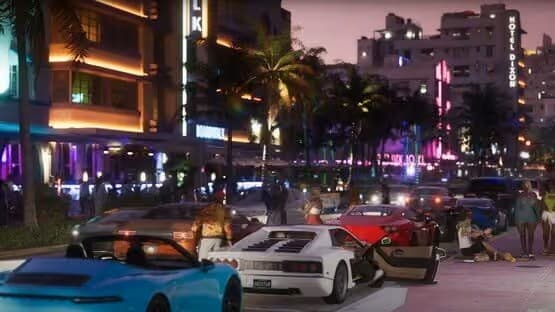
The neon haze hanging over the digital recreation of the Florida Keys does not simply signify an aesthetic homecoming. It marks the culmination of the longest, most scrutinized production cycle in interactive entertainment history. When Grand Theft Auto VI arrives on November 19, 2026, it lands on PlayStation 5 and Xbox Series X consoles not merely as an expensive piece of software. It lands as a macroeconomic event. Thirteen years have slipped away since Rockstar Games last delivered a mainline entry in this franchise. Across those thirteen years, entire console generations shifted, live-service economies devoured mid-tier game development, and Rockstar evolved from a prolific Scottish upstart into an industrial monolith capable of bending the financial currents of global media.
To understand why this franchise commands such immense gravitational pull, one cannot simply gaze at the technical fidelity of the new engine. One must trace the erratic trajectory of a series that began as a pixelated novelty, survived nationwide moral panics, weaponized consumer outrage, and steadily dismantled every standard of commercial scale the games medium ever established.
The Grand Theft Auto series continually rewrote its foundational gameplay loop every time hardware permitted a fresh paradigm shift. The original DMA Design titles in the late 1990s were built around a crude, top-down coordinate system. Their defining mechanical friction was vehicle weight and overhead inertia. When Grand Theft Auto III arrived in October 2001, the studio created a living, three-dimensional ecosystem. That breakthrough rested on emergent state-machine logic where pedestrians possessed simple detection cones and rival mobsters operated on immediate line-of-sight aggression.
The driving mechanics in the early 3D era were notoriously twitchy. They were governed by low-friction tyre traction models that encouraged aggressive handbrake cornering at the expense of authentic vehicle mass. By 2008, Grand Theft Auto IV made an ideological pivot that divided the fan base but laid the mechanical bedrock for the modern era. The protagonist, Niko Bellic, was not an arcade avatar who pivoted on a single frame. He possessed tangible skeletal weight and center-of-gravity shifts that made sprint turns deliberate and cumbersome. Cars handled like two-ton steel bricks riding on soggy suspension coils, rolling heavily through the rain-slicked intersections of Liberty City.
When Grand Theft Auto V arrived in 2013, Rockstar dialed those physical extremes back toward approachable fluidity. Vehicles regained adhesive cornering grip, gunplay adopted the snappy responsiveness of modern cover shooters, and character movement sacrificed procedural momentum for immediate agility. The cynicism of this design shift is obvious in retrospect. Rockstar sanitized the mechanical friction to capture the widest possible demographic. The result was a gameplay loop that felt incredibly smooth but entirely frictionless, designed explicitly to funnel players into the endless, lucrative grind of Grand Theft Auto Online. For the upcoming sixth installment, the design philosophy seems trapped between these two extremes. The tropical environment of Leonida is built on the astonishingly detailed micro-physics established in Red Dead Redemption 2, yet it must simultaneously accommodate the hyper-kinetic demands of a modern multiplayer audience.
Rockstar Games never merely courted controversy. They engineered it into a load-bearing pillar of their corporate identity. In the late 1990s, original series publicist Max Clifford was famously tasked with fanning the flames of British newspaper outrage to ensure the original game became an urgent taboo for teenagers. The studio continued this strategy of provocation through the early 2000s. Grand Theft Auto III generated headlines by allowing players to hire sex workers for health regeneration and subsequently murder them to retrieve their money. Vice City faced severe backlash from Haitian and Cuban advocacy groups over lines of dialogue instructing players to kill specific gang members. British politicians called for bans, tabloids printed breathless editorials, and sales consistently exploded.
Yet this calculated flirtation with moral panic collided head-on with corporate vulnerability during the 2004 release of Grand Theft Auto: San Andreas. Buried deep within the compiled binary files of the game was an unfinished, interactive minigame colloquially named Hot Coffee. In mid-2005, a PC modification enabled these dormant subroutines, allowing players to participate in explicit, rhythm-based sexual encounters with in-game girlfriends.
What followed was an unprecedented regulatory firestorm. The ESRB stripped the game of its Mature rating, slapping it with an Adults Only designation. This instantly prompted major American retailers to pull hundreds of thousands of copies from their shelves. The Federal Trade Commission launched formal inquiries into deceptive marketing practices. United States Senator Hillary Clinton introduced the Family Entertainment Protection Act on the Capitol steps, citing the game as proof of an unregulated interactive industry corrupting youth.
Take-Two Interactive ultimately weathered the storm, but the financial toll was staggering. The publisher was forced to recall and rerelease sanitized discs at an estimated cost of over 50 million dollars. A subsequent class-action lawsuit filed by shareholders and consumers was eventually settled out of court in 2009 for just over 20 million dollars. The lesson learned was seismic. Transgression was profitable when contained within satirical violence, but hidden sexual assets posed an existential threat to public distribution. Across subsequent installments, Rockstar refined its cultural posture. Rather than clumsily provoking politicians, the writing pivoted toward mordant, bitter critiques of American capitalism. The controversy fundamentally shifted. It is no longer about whether video games cause real-world deviance, but whether a cynical interactive satire can outpace the surreal reality of contemporary digital life.
To measure the commercial footprint of Grand Theft Auto against traditional entertainment metrics is to encounter numbers that distort typical market logic. The video game industry boasts numerous iconic franchises, yet none have ever demonstrated the sustained, monolithic revenue generation of Rockstar's flagship property.
Consider the landscape of all-time gaming titans. The Mario franchise sits at roughly 893 million lifetime units sold. Call of Duty boasts over 500 million units, while the Pokemon series hovers around 489 million. The Grand Theft Auto franchise has moved over 465 million units globally. While brands such as Pokemon generate towering multi-billion-dollar empires, their balance sheets rely heavily on physical trading card games, merchandise licensing, anime broadcast rights, and annual split-version software releases. Similarly, the Call of Duty machine relies on relentless annual release schedules, rotating three massive internal studios to push a new retail box every November alongside heavy microtransaction economies.
Grand Theft Auto occupies a totally unique tier. It generates astronomical numbers through singular, generational events. Grand Theft Auto V stands alone as the most profitable standalone entertainment product in human history. With 225 million units sold across three distinct console generations, the title has single-handedly generated in excess of 10 billion dollars in net revenue since its 2013 launch.
The broader Take-Two balance sheet demonstrates that the franchise operates as an independent economic engine. Fueled by the predatory virtual economy of Grand Theft Auto Online, recurring player spending has provided uninterrupted cash reserves. This allowed Rockstar North and its satellite studios to spend near-unlimited budgets and years iterating on a single project without external publisher pressure. When rival studios measure their quarterly projections against industry trends, Take-Two's fiscal reporting often boils down to a single binary variable. Investors simply want to know if Grand Theft Auto is releasing this fiscal year.
The commercial expectations surrounding Grand Theft Auto VI transcend anything previously documented in digital media. Industry financial analysts project that the production and marketing budget easily eclipsed one billion dollars, making it the most expensive media enterprise in history. Yet the market response has dismantled any lingering doubts regarding the publisher's ability to recoup those investments within hours of deployment. Take-Two Interactive CEO Strauss Zelnick recently noted that the game is having an "exceptional start to preorders" and that the company has "not seen anything like this before".
Pre-orders formally opened in the summer of 2026, establishing a new, highly cynical software price ceiling. The Standard Edition debuted at an aggressive 80 dollars, while the Ultimate Edition was priced at 100 dollars. Despite consumer pushback across online forums regarding the baseline price hike, consumer demand broke digital storefront infrastructures. Data tracking firm Sensor Tower estimated that by mid-October 2026, the game had already secured over 6.08 million digital pre-orders. This equates to roughly 594 million dollars in guaranteed revenue before the software has even unlocked for public play. Early analytical data from Newzoo also indicated that the title generated roughly 180 million dollars in digital pre-orders across the US and top European markets within its very first week of availability.
Wall Street projections anticipate that the game will easily exceed one billion dollars in sales within its opening 24 hours, comfortably obliterating the record set by its predecessor in 2013. Factoring in digital pre-loading windows, midnight server activations, and the inevitable rollout of a next-generation online casino disguised as a multiplayer mode, the title is positioned to harvest billions in gross software revenue during its initial launch quarter alone. It represents a financial velocity that no other software product on Earth can replicate. It is a retail occurrence capable of moving global consumer electronics hardware, driving paid subscription spikes, and clearing the release calendars of competing publishers for months in either direction.
The nineteenth of November holds a storied pedigree in the annals of interactive design, having played host to foundational milestones across disparate eras of hardware.
Half-Life (November 19, 1998): Valve's debut masterpiece fundamentally rewrote the first-person shooter lexicon. It abolished detached cinematic cutscenes in favor of unbroken, first-person environmental storytelling and razor-sharp scripted pacing inside the Black Mesa Research Facility.
Uncharted: Drake's Fortune (November 19, 2007): Naughty Dog's initial pulp adventure laid the cinematic motion-capture groundwork and witty, character-driven storytelling that defined Sony's modern first-party identity for the next two decades.
Ronan Patrick – "GTA 6's First Week Opens the Strongest Pre-order Campaign on Record" (Newzoo, 2026) - https://newzoo.com/articles/gta-6-first-week-pre-order-sales
Reddit Community – "Video Game Industry Revenue Expected to Reach $214 Billion in 2026 With 'GTA 6' Release, New Report Finds" (Reddit r/xbox, 2026) - https://www.reddit.com/r/xbox/comments/1wfd07r/video_game_industry_revenue_expected_to_reach_214/
Aaron Trueman – "GTA 6 Pre-Order Numbers Are 'Exceptional' Says Take-Two Interactive" (Rockstar Intel, 2026) - https://rockstarintel.com/gta-6-pre-order-numbers-are-exceptional-says-take-two-interactive-raises-revenue-projections/
Shane the Gamer Research Team – "Best-Selling Video Games of All Time: 2026 Statistics" (Shane the Gamer, 2026) - https://www.shanethegamer.com/research/best-selling-video-games-facts/
Wikipedia Contributors – "Half-Life (video game)" (Wikipedia, 2026) - https://en.wikipedia.org/wiki/Half-Life_(video_game
IGN Staff – "Fall 2007 Was the Greatest Stretch in Gaming" (IGN, 2026) - https://www.ign.com/articles/fall-2007-was-the-greatest-stretch-in-gaming-and-definitely-xbox-history
Tor Thorsen – "'Hot Coffee,' stock-option suit settled for $20.1 million" (GameSpot, 2009) - https://www.gamespot.com/articles/hot-coffee-stock-option-suit-settled-for-201-million/1100-6216620/
No comments yet. Be the first.