Dispatch
Every GTA Game in Order, and Where GTA 6 Fits

franchise
Grand Theft Auto
Dispatch
franchise
Grand Theft Auto
Keep Reading
 Bombjack
Grand Theft Auto is one of those series that everybody has a story about. Maybe it was the first time you nicked a car in a top-down Liberty City and promptly drove it into the sea. Maybe it was Vice City's soundtrack burning itself into your brain forever. Maybe you've simply spent the last decade watching a mate buy his fourth flying motorbike in GTA Online and quietly questioning his life choices.
Whatever your story, the series has had a remarkably strange journey. It started life in Dundee as a game about being a policeman, picked up a tabloid storm before anyone had played it, moved its creative home to New York, survived a sex scandal that wasn't really a sex scandal, and then spent most of the 2020s making us wait for a sixth instalment. That wait finally ends on 19 November 2026.
So, with Leonida on the horizon, here's every Grand Theft Auto game in release order, the people and companies behind them, the story timeline (which is less tidy than you'd hope), and where Vice City fits into the whole sorry, glorious mess.
If you just want the order and have a car to steal, here you go. Dates are the first release anywhere in the world, followed by the launch platforms and the developer.
Grand Theft Auto: 28 November 1997 (Europe). MS-DOS / Windows. Developed by DMA Design.
Grand Theft Auto: London 1969: 30 April 1999. PC, PlayStation. Developed by Rockstar Canada (PlayStation port by Runecraft).
Grand Theft Auto: London 1961: 1 July 1999. PC (free download). Developed by Rockstar Canada.
Grand Theft Auto 2: 22 October 1999. PC, PlayStation. Developed by DMA Design.
Grand Theft Auto III: 23 October 2001 (North America). PlayStation 2. Developed by DMA Design.
Grand Theft Auto: Vice City: 29 October 2002 (North America). PlayStation 2. Developed by Rockstar North.
Grand Theft Auto Advance: 26 October 2004 (North America). Game Boy Advance. Developed by Digital Eclipse.
Grand Theft Auto: San Andreas: 26 October 2004 (North America). PlayStation 2. Developed by Rockstar North.
Grand Theft Auto: Liberty City Stories: 25 October 2005 (North America). PSP. Developed by Rockstar Leeds and Rockstar North.
Grand Theft Auto: Vice City Stories: 31 October 2006 (North America). PSP. Developed by Rockstar Leeds and Rockstar North.
Grand Theft Auto IV: 29 April 2008. PS3, Xbox 360. Developed by Rockstar North.
GTA IV: The Lost and Damned: 17 February 2009. Xbox 360. Developed by Rockstar North.
Grand Theft Auto: Chinatown Wars: 17 March 2009 (North America). Nintendo DS. Developed by Rockstar Leeds and Rockstar North.
GTA: The Ballad of Gay Tony: 29 October 2009. Xbox 360. Developed by Rockstar North.
Grand Theft Auto V: 17 September 2013. PS3, Xbox 360. Developed by Rockstar North.
Grand Theft Auto Online: 1 October 2013. PS3, Xbox 360. Developed by Rockstar North.
GTA: The Trilogy, The Definitive Edition: 11 November 2021. PC, PS4, PS5, Xbox One, Series X/S, Switch. Developed by Grove Street Games.
Grand Theft Auto VI: 19 November 2026. PS5, Xbox Series X/S. Developed by Rockstar Games.
A couple of fun things jump out of that list. Grand Theft Auto Advance and San Andreas launched in North America on the very same day, which must have made for a confusing birthday list in 2004. And Rockstar clearly has a thing for October, which explains why so many of us have spent our autumns indoors.
Now for the actual story.
The whole thing starts with DMA Design, a studio founded in Dundee in 1988 by David Jones. Before Grand Theft Auto, DMA was famous for something altogether more wholesome: Lemmings, the 1991 puzzler where you guided suicidal little green-haired chaps to safety. Not exactly the obvious pedigree for a game about running people over.
GTA began development in April 1995 under the name Race'n'Chase, and early on you were the one wearing the badge, chasing down the bad guys. Being a copper turned out to be a bit dull, so the team flipped it and put you on the wrong side of the law instead.
Then there's the famous bug. As designer Gary Penn tells it, broken route-finding code made the police cars go completely mental, trying to drive straight through you rather than around you. Instead of fixing it, the team kept it in, because being hunted by hilariously unhinged police turned out to be brilliant fun. I find that oddly comforting, given how many of my own bugs have only ever produced error messages.
One of the most iconic things about GTA, its psychotic police, exists because somebody looked at a bug and decided it was a feature.
The original Grand Theft Auto landed in Europe on 28 November 1997 on PC, with a PlayStation version following in December. It was top-down, chunky and gloriously anarchic, and it featured three cities that would become the series' holy trinity: Liberty City, San Andreas and Vice City. The PC version even let you pick from eight characters, half of them women, although it was a purely cosmetic choice.
Before most people had played it, though, GTA was already notorious. DMA brought in the publicist Max Clifford, who fed the violent details to the tabloids, and the game was even raised in the House of Lords in May 1997. The outrage did exactly what it was designed to do. Everybody wanted to play the game their parents were being told to fear.
GTA picked up an expansion in April 1999, Grand Theft Auto: London 1969, made by Rockstar Canada for PC, with Runecraft handling the PlayStation version. Swapping American cities for swinging sixties London was a wonderfully British idea, complete with driving on the left and more cockney than a Guy Ritchie film.
A free follow up, London 1961, arrived as a PC download in July 1999. Confusingly, it's set before London 1969 despite coming out after it. If you're already struggling with that, I'd advise sitting down before we get to the timeline section.
Behind the scenes, ownership was moving about like a getaway driver changing lanes. Gremlin Interactive bought DMA Design in 1997, then Gremlin was swallowed by Infogrames in 1999. Meanwhile, Take-Two Interactive had bought GTA's publisher, BMG Interactive, in 1998, which brought the GTA rights with it.
In December 1998, Rockstar Games was founded in New York by Sam Houser, Dan Houser, Terry Donovan, Jamie King and Gary Foreman. In September 1999, Take-Two bought DMA Design from Infogrames, which neatly reunited the people who made GTA with the people who now owned it. In 2002, DMA was renamed Rockstar North, and the Scottish studio has been the beating heart of the series ever since.
Grand Theft Auto 2 arrived on 22 October 1999 for PC and PlayStation, followed later by Dreamcast and Game Boy Color versions. It was set in Anywhere City, a retro-futuristic metropolis at some unspecified point in the near future, and it introduced a respect system where doing jobs for one gang made the others like you a lot less. A bit like being the only person in the office who brings biscuits for one team.
It was also promoted with a live-action short film written by Dan Houser, and that film is where the name Claude Speed comes from, since the game itself barely bothers naming you. GTA 2 was good fun, but it was about to be completely overshadowed by what came next.
On 23 October 2001, Grand Theft Auto III arrived on PlayStation 2 and changed open world games forever. For the first time, Liberty City was a full 3D place you could walk, drive and cause havoc in, built on the RenderWare engine. You played a silent protagonist, betrayed and left for dead, who wouldn't officially get a name until a later game. (It's Claude. Again.)
The release came just six weeks after the September 11 attacks, and Rockstar pushed the game back by three weeks to make some changes. Liberty City's coppers lost their NYPD-style blue and white paint job in favour of black and white. An aircraft that seemed to vanish behind a tower block was given a new route, a mission that mentioned terrorists was dropped, and some pedestrian chatter, radio content and the American box art were swapped out. A few popular rumours, such as the Dodo plane being grounded because of 9/11, have been denied by Rockstar, so take any "cut content" story you see online with a large pinch of salt.
III was a phenomenon. Suddenly every publisher wanted a "GTA clone" and the term became its own genre.
If GTA III was the big bang, Grand Theft Auto: Vice City was the party afterwards. Released on PS2 on 29 October 2002 in North America and 8 November 2002 in Europe, it dragged us back to 1986 and dropped us into a Miami-flavoured city drenched in pastel suits and Scarface references.
You played Tommy Vercetti, voiced by the late Ray Liotta, a mobster fresh out of prison and looking for his money. The cast was absurdly stacked for a video game at the time, with Dennis Hopper, Burt Reynolds, Gary Busey, Danny Trejo, and Philip Michael Thomas (Miami Vice himself) as Tommy's mate Lance Vance. Then there was the soundtrack, which was basically a perfect eighties mixtape that you could drive around in.
It shifted well over a million copies before its first weekend was even out, and by 2008 it had passed 17 million. Ask a certain generation of gamers about their favourite GTA and a surprising number will say this one before you've finished the question.
Grand Theft Auto: San Andreas came out on 26 October 2004 and somehow fitted three cities, the countryside, deserts and a mountain onto a single PS2 disc. Set in 1992, it followed Carl "CJ" Johnson, voiced by Young Maylay, returning home to Grove Street after his mum's death and getting dragged back into gang life, harassed constantly by Samuel L. Jackson's crooked cop, Officer Tenpenny.
San Andreas added RPG systems, gym sessions, eating, haircuts, swimming, jetpacks and that infamous train mission. Across every platform it sold around 27.5 million copies, and its 17 million-plus sales on PS2 alone make it the best-selling game the console ever had.
It also gave us the series' biggest controversy. In 2005, a PC mod called Hot Coffee unlocked an unfinished sex minigame that had been left buried in the game's code. The ESRB re-rated the game Adults Only, retailers pulled it off shelves, and Take-Two ended up settling with the US Federal Trade Commission and a class action lawsuit. All for content you couldn't actually reach without a mod or a cheat device. Leaving old code lying around has never been more expensive.
While the PS2 games hogged the headlines, Rockstar was also busy making GTA portable.
Grand Theft Auto Advance (Game Boy Advance, October 2004) was developed by Digital Eclipse and went back to a top-down view, telling the story of a criminal called Mike in a 2000-era Liberty City.
Liberty City Stories (PSP, October 2005) and Vice City Stories (PSP, October 2006) were developed by Rockstar Leeds with Rockstar North, and both later got PS2 ports. They were proper 3D GTA games that fit in your pocket, which still feels like witchcraft. Liberty City Stories stars Toni Cipriani in 1998, while Vice City Stories follows Victor Vance, Lance's brother, in 1984.
Then in March 2009 came Chinatown Wars for Nintendo DS, which went top-down again, starred Huang Lee, and somehow made drug dealing feel like a stock market minigame. It later came to PSP and mobile, and it's arguably the most underrated game in the series.
On 29 April 2008, Grand Theft Auto IV launched on PS3 and Xbox 360 and kicked off a brand new continuity, now known as the HD universe. Built on Rockstar's RAGE engine with Euphoria physics, it brought us a darker, heavier Liberty City and Niko Bellic, voiced by Michael Hollick, an Eastern European war veteran chasing the American dream and his own past.
It was a monster at launch, making over $500 million in its first week, with a budget that Leslie Benzies estimated at over $100 million. It was also, crucially, the game where your cousin Roman would ring every five minutes to ask if you wanted to go bowling. Some of us are still not ready to talk about it.
IV got two excellent episodes in 2009: The Lost and Damned, following biker Johnny Klebitz, and The Ballad of Gay Tony, following nightclub bodyguard Luis Lopez. Both were later bundled as Episodes from Liberty City.
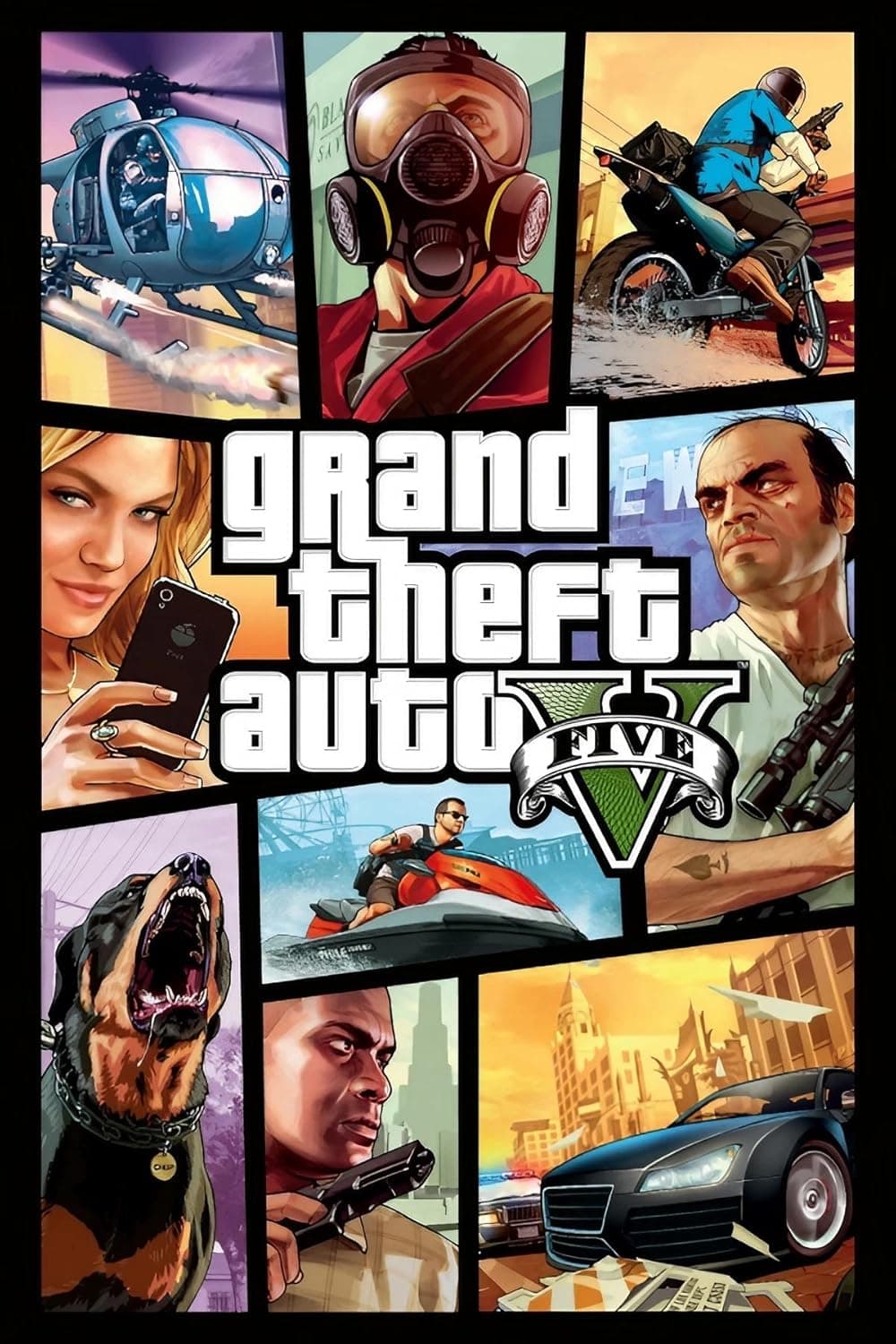
Then came the juggernaut. Grand Theft Auto V launched on 17 September 2013, and it was a billion dollar game within three days, which is quicker than it takes me to finish most games. Guinness handed it a small pile of world records for its trouble. Analysts reckoned the development and marketing bill came to roughly $265 million, which, looking at those first few days, Take-Two probably earned back before lunch.
V split the story across three protagonists you could switch between: Michael De Santa, a retired robber in a midlife crisis; Franklin Clinton, a young hustler looking for a way up; and Trevor Philips, who is best described as a walking HR incident. The heists were brilliant and Los Santos was a gorgeous satire of Los Angeles.
GTA Online followed on 1 October 2013, and honestly, it's the reason GTA 6 took so long. It was rocky at launch, but it grew into one of the most profitable entertainment products ever made. GTA V itself was re-released on PS4 and Xbox One in 2014, PC in 2015, and PS5 and Xbox Series X/S in 2022, and Take-Two now puts it at over 230 million copies shipped. That's three console generations of people buying the same game, and if you're one of them, don't worry, you're in very large company.
In November 2021, Rockstar released Grand Theft Auto: The Trilogy, The Definitive Edition, remastering III, Vice City and San Andreas. It was developed by Grove Street Games, and to put it kindly, it did not go well.
The launch was riddled with bugs, the new character models looked like they'd been left out in the rain, and the rain itself was so thick you couldn't see where you were going. The PC version was even pulled from sale for three days just after launch. To make things worse, the original versions had been quietly removed from digital stores about a month earlier. After the backlash, Rockstar apologised and gave Definitive Edition owners the classic PC versions for free. It's since been patched a fair bit and even turned up on Netflix Games in late 2023, but first impressions are hard to shake.
The 2010s and 2020s saw some big changes at the top. Leslie Benzies, the long-time president of Rockstar North, left the company in 2016 and sued Take-Two over royalties, a case that settled in 2019. Dan Houser, co-founder and the writer behind so much of GTA's voice, left Rockstar in March 2020 and later set up Absurd Ventures.
Then in September 2022, around 90 clips of early GTA 6 footage leaked online in what was one of the biggest leaks in gaming history. The hacker behind it, Arion Kurtaj, a teenager linked to the Lapsus$ group, was given an indefinite hospital order by a UK court in December 2023.
More recently, in October 2025, Rockstar dismissed 34 staff, 31 of them at Rockstar North. The company said they'd shared confidential information publicly, while the IWGB union called it union busting. At the time of writing, the employment tribunal in Glasgow is due to wrap up its hearing in mid-October, with a judgment still to come.
GTA 6 was officially revealed with its first trailer on 4 December 2023, a few hours ahead of schedule because, inevitably, it had leaked. It racked up around 90 million YouTube views in 24 hours, a Guinness World Record for a video game reveal. Rockstar said Trailer 2 in May 2025 did 475 million views across platforms in its first day, which is frankly ridiculous.
The release date has been a moving target:
December 2023: Trailer 1 promises a 2025 release
May 2025: Delayed to 26 May 2026
November 2025: Pushed back again to 19 November 2026, with Rockstar saying it needed more time to finish the job properly
As of today, that November date is still holding, pre-orders have been open since June, and it's coming to PS5 and Xbox Series X/S, with no PC version announced. PC players, I feel your pain. We'll be here in 2027 or so, waiting patiently.
GTA 6 is set in Leonida, Rockstar's take on Florida, and stars Lucia Caminos and Jason Duval, a criminal couple who are very much giving off Bonnie and Clyde energy. Lucia is the series' first fixed female protagonist, which is overdue for a series that let PC players pick a female character way back in 1997. And the big headline for longtime fans? Vice City is back.
Here's where it gets fiddly. GTA isn't one continuous timeline. Rockstar splits its games into three separate universes, and characters and cities don't carry over between them.
The top-down originals, which have their own loose continuity.
London 1961: London, 1961
London 1969: London, 1969
Grand Theft Auto: Liberty City, San Andreas and Vice City
Grand Theft Auto 2: Anywhere City, at some unspecified point in the near future
The PS2 era and its spin-offs. This is where the chronology really diverges from release order.
Vice City Stories (1984): Victor Vance
Vice City (1986): Tommy Vercetti
San Andreas (1992): Carl "CJ" Johnson
Liberty City Stories (1998): Toni Cipriani
GTA Advance (2000): Mike
Grand Theft Auto III (2001): Claude
So Victor Vance, who you meet briefly at the start of Vice City, gets his own prequel. And Claude, the silent hero of GTA III, actually pops up in San Andreas in 1992 as Catalina's new partner, which is where he finally gets his name. Toni Cipriani, Salvatore Leone and Donald Love from GTA III all come back for Liberty City Stories too.
A fresh continuity starting with GTA IV.
GTA IV, The Lost and Damned, The Ballad of Gay Tony (2008): Niko Bellic, Johnny Klebitz, Luis Lopez
Chinatown Wars (2009): Huang Lee
GTA V (2013): Michael, Franklin, Trevor
GTA Online (2013 onwards): You (and your terrible outfit)
GTA VI (present day): Lucia Caminos, Jason Duval
The three IV stories run alongside each other and cross paths throughout, which is still one of the cleverest things Rockstar has done.
This is the bit that trips people up, because Vice City has actually existed in all three universes.
The 2D Vice City was one of the three cities in the original 1997 Grand Theft Auto.
The 3D Vice City is the neon-soaked 1980s city from Vice City (1986) and Vice City Stories (1984), home to Tommy, Lance and Victor.
The HD Vice City is the one we're getting in GTA 6, a present-day city within the larger state of Leonida.
Because the universes are separate, GTA 6's Vice City isn't the same place Tommy Vercetti built his empire in. Think of it as a reimagining of the same city, rather than a sequel to it. That's the same thing Rockstar did with Liberty City in GTA IV and Los Santos in GTA V. So no, you probably shouldn't expect to bump into a 70-year-old Tommy running a pastel suit shop on Ocean Beach. More's the pity.
In release order, GTA 6 is the 18th entry on our list (counting expansions, spin-offs and that remaster), and the first new mainline game in 13 years. When GTA V came out, the PS4 hadn't even launched yet.
In story order, it sits at the very end of the HD universe, after GTA IV, Chinatown Wars, GTA V and the ongoing chaos of GTA Online. It's set in the present day, so it's the latest point in the HD timeline so far.
And in spirit? It's very much a return home. The series that started in Dundee with a bug that made the police too aggressive is heading back to the sunshine of Vice City, nearly thirty years after the original. If the police in Leonida are half as unhinged as they were in 1997, Gary Penn's happy accident will have come full circle.
I'll see you there on 19 November. I'll be the one stuck in a pastel suit, driving into the sea.
Written by TokenGeek for VGDB
No comments yet. Be the first.