-
Average rating
22
Games
0
Votes cast
Heartbeat
Shipped Titles
Games (22)
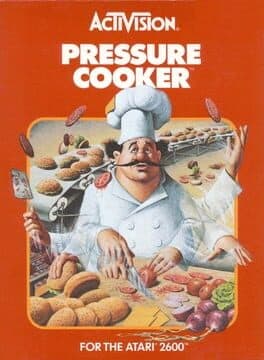
Pressure Cooker
Activision1983
Business is booming at "The Grille". Hamburger orders are just pouring in. But back in the Assembly Room, the Food Dispenser is pouring out condiments everywhere. Help Short-Order Sam fill each order with the proper combination of tomatoes, onions, lettuce and cheese. And don't forget the bun! Then, rush the completed orders to the Wrapping Room fast. Alright cooks, grab your spatulas!
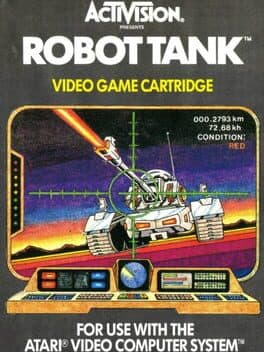
Robot Tank
Activision1983
There are numerous enemy tanks crossing the countryside, destroying everything in their path! Your job is to command a robot tank to stop them. Robot Tank is a first person perspective arcade style action game. There are twelve squadrons of tanks to destroy, each containing twelve tanks. Each time you destroy a complete squadron, you earn an extra reserve tank before moving on to the next, more difficult squadron. The game takes place twenty four hours a day; gameplay will alternate from early morning to mid afternoon to late at night. In addition to the constantly changing time of day, the weather can also change unexpectedly. Snow, rain, and fog will appear occasionally making it tougher to spot your targets. Luckily your tank is equipped with radar to help locate the enemy when visibility is poor. As your tank takes damage you will lose some capabilites, such as speed, the radar, or your canons. If your tank takes too much damage, it will be destroyed; the game ends when all of your reserve tanks are gone.
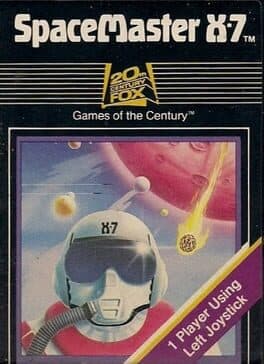
SpaceMaster X-7
Sirius Software1983
Your assault ship was specially designed to destroy Hyperion Military Bases. Destroy as many as possible. You can fire missiles in the gaps in the Force Field or from inside the Force Field. If you are able to sneak inside, you must quickly destroy the bace before the Force Field closes on your ship. This is no easy task!
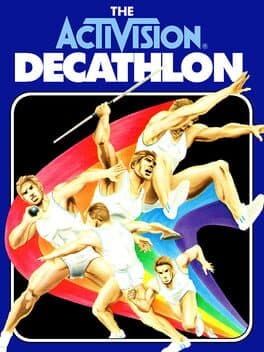
The Activision Decathlon
Activision1983
The Activision Decathlon offers a comprehensive Olympic-style gaming experience, simulating all ten events of a real-life decathlon. Players can compete solo or with up to three others, tackling events such as sprints, jumps, and throws, either in sequence or individually. The gameplay mechanics blend rapid joystick movements with precise button timing, challenging players to balance speed and accuracy. Events like running require vigorous joystick waggling, while hurdles and field events demand well-timed button presses for optimal performance. Points are awarded based on performance in each event, with the highest overall score earning the coveted gold medal, creating an engaging and competitive virtual athletic experience.
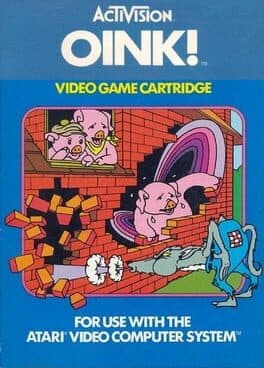
Oink!
Activision1983
Oink! is based on the fairy tale of the three little pigs. The big bad wolf is trying to blow down each of the pigs houses. You control each pig one at a time. The wolf is at the bottom of the screen and will blow a hole in the house one section at a time. Each time a hole is formed, the pig must patch it up quickly so the wolf can't get in. New materials are located at the top of the screen, and you need to grab them and place them in the holes as they are formed. The longer you last, the tougher the wolf will become! You start the game controlling the pig whose house is made of straw; when he is caught, you move on to the pig in the house made of sticks. Finally you will control the pig in the house made of bricks. When all three pigs have been caught by the wolf, the game is over.
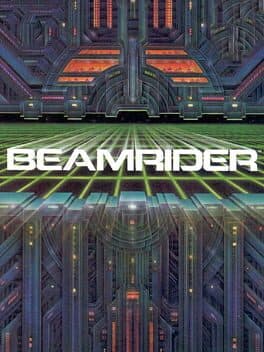
Beamrider
Cheshire Engineering1983
A web of iridescent blue beams engulfs Earth-Space. You stand watching. Mesmerized at first, you now realize the beams support weapons, frightening creations in different forms. Will you just watch or will you take action? Action??!! Then roll up your sleeves, mount these beams and... ride! Animated graphics create a 3D perspective that virtually pulls you into the screen. Pulsating sound effects intensify the action as a dizzying array of objects zips from beam to beam.
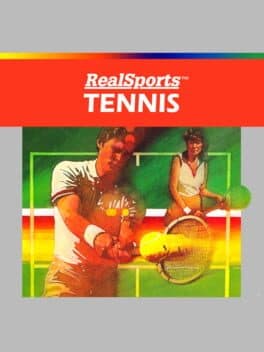
RealSports Tennis
Atari1983
RealSports Tennis is a tennis simulation video game developed by Atari, Inc. for the Atari 2600, and published in 1983.
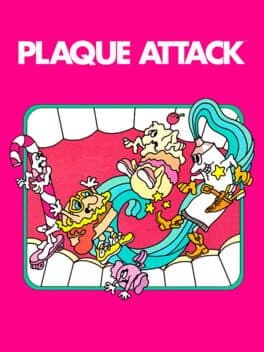
Plaque Attack
Activision1983
Plaque Attack is a 1983 video game for the Atari 2600 that was made by Activision. Loosely based on Space Invaders, the player must prevent food from destroying teeth in a person's mouth. Steve Cartwright, who designed the game, said that game was meant to help people develop good dental habits.
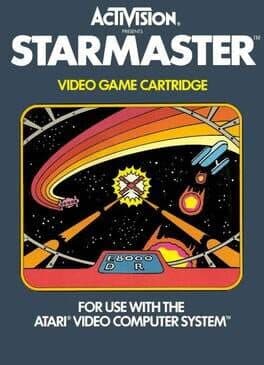
Starmaster
Activision1982
In the game the player pilots a starfighter, with the purpose of destroying a number of enemy ships before they destroy four friendly starbases. Gameplay is presented mostly in first person cockpit view, which is achieved with surprisingly good effect given the 2600's primitive graphics capabilities. The starfighter carries laser weapons, shields, and a faster-than-light drive. The fighter also carries a limited energy supply, which is drained by firing the lasers, being hit by enemy fire, warping, or simply flying around. If the ship's energy drops to zero it is destroyed, and the game ends. Enemy fire can knock out the fighter's subsystems (such as weapons) on top of draining energy. The game "universe" is a square-shaped galaxy mapped into a grid of 36 sectors. Each sector can be home to some enemy ships, a starbase, both, or nothing. The player "warps" the fighter to a sector to engage enemy ships; once they are all destroyed, the player moves on to another. The player can also warp to a sector with a starbase, and dock with it (a rather tricky process) to replenish energy and repair damaged subsystems. Enemy ships in turn maneuver through the galaxy as they home in to destroy the starbases. The game is won when all enemy ships are destroyed, or lost if either the player's fighter or all four starbases are destroyed.
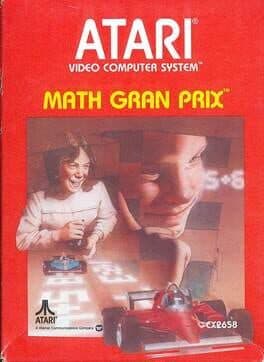
Math Gran Prix
Atari1982
The principle of the game is to fuel your car with correctly answered math questions. It can move 2 to 3 spaces depending on how hard the math problem is. The track contains many triggers that can give extra spaces, extra turns, and even keep your car on the track. There are areas in the track where a car coming from behind can knock you off, to get back answer a math problem correctly. In the end, the one with the most math skills and greatest planning effort will win the checkered flag.
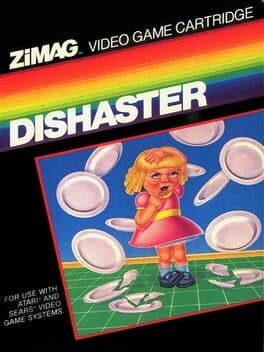
Dishaster
ZiMAG1982
Dishaster is an action game released for the Atari 2600 in 1983 by Zimag. Another version of the game was released by Bit Corporation under the name Dancing Plates which features oriental-themed graphics and adds eight game variations. Dishaster was inspired by the circus tradition of keeping spinning plates suspended on poles. The player controls a girl attempting to keep a group of several spinning plates balanced on poles from falling. The game received negative reviews; criticism focused on the game's repetition and monotony. The girl can stabilize wobbling dishes by pressing the button on the controller. If a plate falls, the player is able to capture it if the girl touches it before it hits the ground, and a new one appears at the top of the pole. The number of poles to spin varies between the selected skill level; there are six on the easiest setting, and ten on the hardest. The player loses if they let four dishes hit the ground

RealSports Volleyball
Atari1982
RealSports Volleyball is an enhanced version of programmer Bob Polaro's never released game Volleyball. He asked to make several improvements on it, including better animations and more colourful backgrounds. It is part of the RealSports series of games.
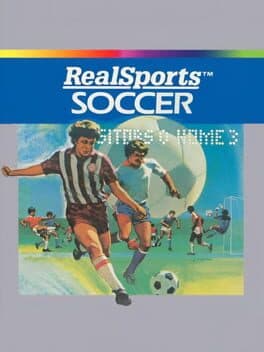
RealSports Soccer
Atari1982
RealSports Soccer is Atari's second attempt at a soccer game for the Atari 2600. You can choose from one of 12 different games, and play either solo or against a friend as you pass and shoot your way to victory (or defeat). Each team has three players with a specific area of the field to cover. A game lasts five or nine minutes and can be played on one of three difficulty levels, with each increasing the speed of gameplay and skill of the computer players.
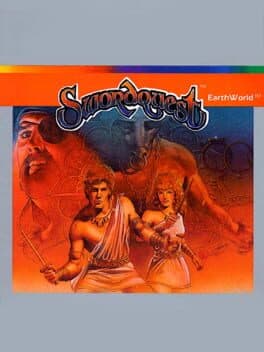
Swordquest: Earthworld
Atari1982
Swordquest is an unfinished series of video games produced by Atari, Inc. in the 1980s as part of a contest, consisting of three finished games and a planned but never released fourth game. All of the games came with a comic book that explained the plot, as well as containing part of the solution to a major puzzle that had to be solved to win the contest. Each game had essentially the same gameplay: Logic puzzle adventure style gaming interspersed with arcade style action gaming. The character wanders through each screen, picking up and dropping items, playing simplified variants of current 'twitch' games of the time between screens. If the correct items are placed in a room, a clue shows up, pointing the player to a page and panel in the comic book included with the game. There, the player would find a word that was hidden in that panel. If the player found all five correct clues, amongst all the hidden words (hinted by a hidden clue in the comic), they could send the sentence to Atari and have a chance to compete in the finals and win a prize. Earthworld was the first of the four games. Its room structure was based on the signs of the zodiac.
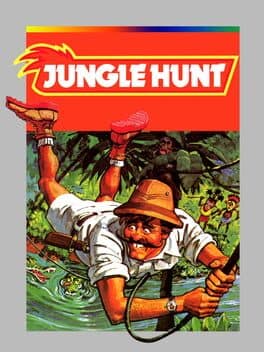
Jungle Hunt
Taito1982
Jungle Hunt is side-scrolling arcade game produced and released by Taito in 1982. It was initially released as Jungle King. Jungle Hunt is one of the first video games to use parallax scrolling. The player controls an unnamed jungle explorer sporting a pith helmet and a safari suit. The player attempts to rescue his girl from a tribe of hungry cannibals by swinging from vine to vine, swimming a crocodile-infested river, jumping over or ducking beneath rolling rocks, then releasing the girl before she is lowered into a boiling cauldron. Home versions were released for the Apple II, Atari 2600, Atari 5200, Atari 8-bit family, Commodore 64, ColecoVision, VIC-20, and IBM PC. The PC version was developed by Sierra On-Line and is incompatible with everything except an original IBM PC/XT with a CGA video card. In the Atari-ported versions the hero is named Sir Dudley, and the girl, married to Sir Dudley, is Lady Penelope.
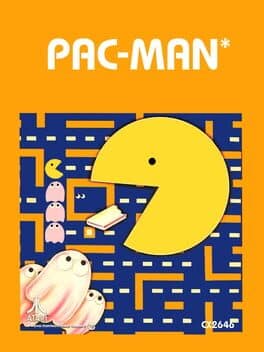
Pac-Man
Namco1982
Atari 2600 Port of Pac-Man The player controls Pac-Man through a maze, eating pac-dots (also called pellets). When all pac-dots are eaten, Pac-Man is taken to the next stage. Between some stages one of three intermission animations plays. Four enemies (Blinky, Pinky, Inky and Clyde) roam the maze, trying to catch Pac-Man. If an enemy touches Pac-Man, a life is lost and the Pac-Man itself withers and dies. When all lives have been lost, the game ends. Pac-Man is awarded a single bonus life at 10,000 points by default. Near the corners of the maze are four larger, flashing dots known as power pellets that provide Pac-Man with the temporary ability to eat the enemies. The enemies turn deep blue, reverse direction and usually move more slowly. When an enemy is eaten, its eyes remain and return to the center box where it is regenerated in its normal color. Blue enemies flash white to signal that they are about to become dangerous again and the length of time for which the enemies remain vulnerable varies from one stage to the next, generally becoming shorter as the game progresses. In later stages, the enemies go straight to flashing, bypassing blue, which means that they can only be eaten for a short amount of time, although they still reverse direction when a power pellet is eaten; in even later stages, the ghosts do not become edible (i.e., they do not change color and still make Pacman lose a life on contact), but they still reverse direction.
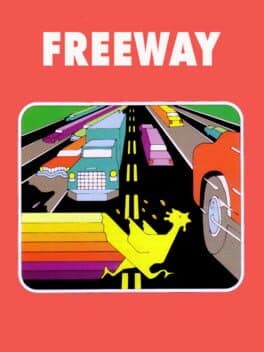
Freeway
Activision1981
Freeway is a video game designed by David Crane for the Atari 2600 video game console. It was published by Activision in 1981. One or two players control chickens who can be made to run across a ten lane highway filled with traffic in an effort to "get to the other side." Every time a chicken gets across a point is earned for that player. If hit by a car, a chicken is forced back either slightly, or pushed back to the bottom of the screen, depending on what difficulty the switch is set to. The winner of a two player game is the player who has scored the most points in the two minutes, sixteen seconds allotted. The chickens are only allowed to move up or down. A cluck sound is heard when a chicken is struck by a car. Comparisons are often made to Frogger, which has also features crossing a street filled with moving vehicles. Similarities did help sales when Frogger was popular in the arcades and a home version was not yet available. Freeway was made available on Microsoft's Game Room service for its Xbox 360 console and for Windows-based PCs on August 18, 2010.
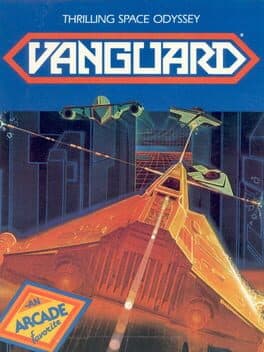
Vanguard
Tose1981
Vanguard is a thrilling multiplayer party game that blends arcade-style visuals and gameplay with a diverse array of competitive modes. Perfect for gamers of all skill levels, it offers fast-paced action, strategic depth, and whimsical fun for an inclusive and dynamic gaming experience.
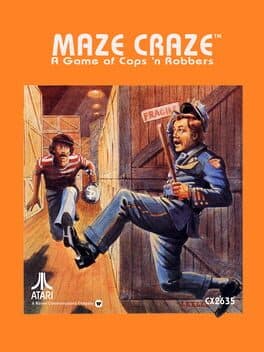
Maze Craze: A Game of Cops 'n Robbers
Atari1980
In Maze Craze, your goal is to be the first of two players to make it out of a maze! Each player controls a cop that starts on the left, and the first player to make it out the exit on the right wins. The game also includes of variety of options. The maze can be completely visible, completely invisible, or have just a few parts invisible. With invisible mazes you can optionally have the computer provide a sneak peak at the complete maze periodically. To make your task more challenging, one to five robbers may also be placed in the maze. If you are caught by one of the robbers, you will momentarily be stunned giving your opponent an advantage. You can also give your cop the ability to set up a blockade to confuse your opponent. This will look like a regular wall, however you can walk straight through it. The games speed can also be adjusted, from calculatingly slow to extremely fast.
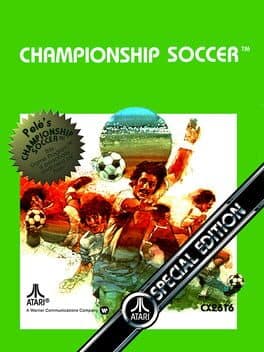
Championship Soccer
Atari1980
Championship Soccer is a soccer game where each team has one forward, two backs and a goalie. The forward and backs always run in formation. You only control the goalie when he has the ball, otherwise he is computer controlled.
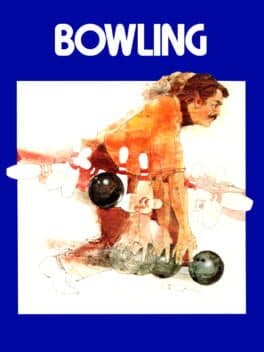
Bowling
Atari1979
The game is based on the game of bowling, playable by one player or two players alternating. In all six variations, games last for 10 frames, or turns. At the start of each frame, the current player is given two chances to roll a bowling ball down an alley in an attempt to knock down as many of the ten bowling pins as possible. The bowler (on the left side of the screen) may move up and down his end of the alley to aim before releasing the ball. In four of the game's six variations, the ball can be steered before it hits the pins. Knocking down every pin on the first shot is a strike, while knocking every pin down in both shots is a spare. The player's score is determined by the number of pins knocked down in all 10 frames, as well as the number of strikes and spares acquired.
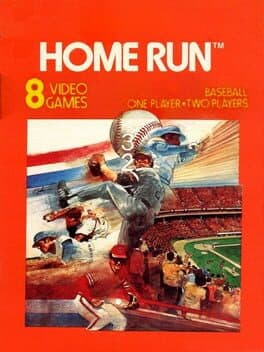
Home Run
Atari1978
This is the first of three iterations of baseball from Atari and is the most simple. The pitcher pitches and controls the direction of the ball. The batter hits and keeps running until he's made to stop. There are up to 3 defensive players that can try to get the batter out after he hits. All hits are grounders and defensive players can't throw the ball.